
What is Chitosan?
Chitosan is considered one of the most promising biomaterials of the 21st century due to its versatile nature, excellent biodegradability, biocompatibility, antimicrobial and antibacterial cathiodical activity, non-toxicity and its many applications. Chitosan is derived from chitin, the second most abundantly available natural biopolymer after cellulose. Chitin is found naturally in the exoskeleton of crustaceans such as crabs and shrimp, and in the cell membranes of fungi, yeasts and other microorganisms. Chitin is not soluble in dilute acids, while Chitosan is soluble in dilute acids. Chitosan is mainly composed of glucosamine and N-acetyl glucosamine residues with a 1, 4-β bond. The presence of primary amines (-NH2) in Chitosan gives it a net positive charge and is important for its biological properties.
Types of transformation of chitosan
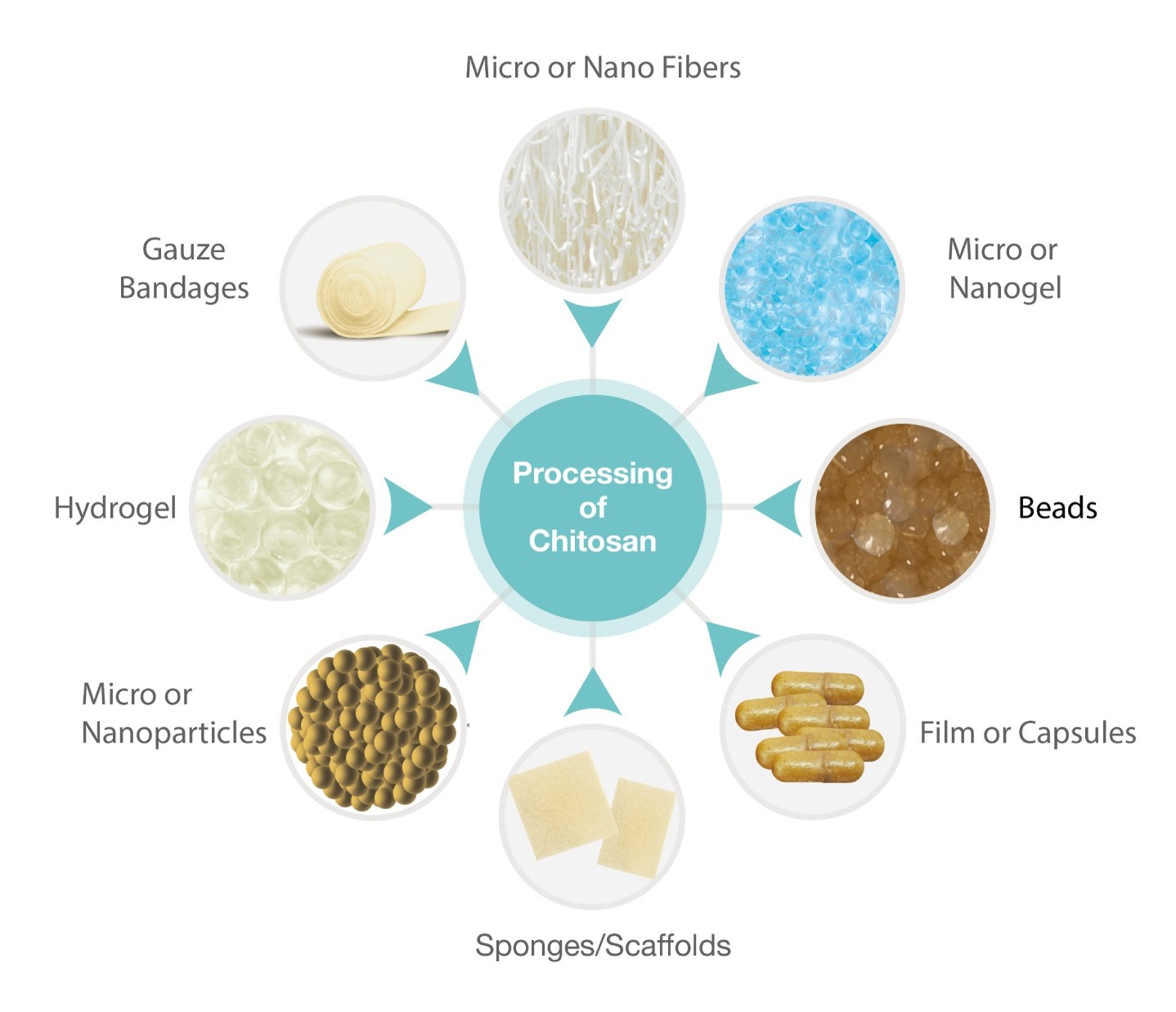
Chitosan is an extremely versatile biomaterial. It can be made into various forms such as micro or nanofibers, micro or nanogels, beads, films or capsules, sponges or scaffolds, micro or nanoparticles, hydrogel and gauzes.
The Biologics Properties of Chitosan
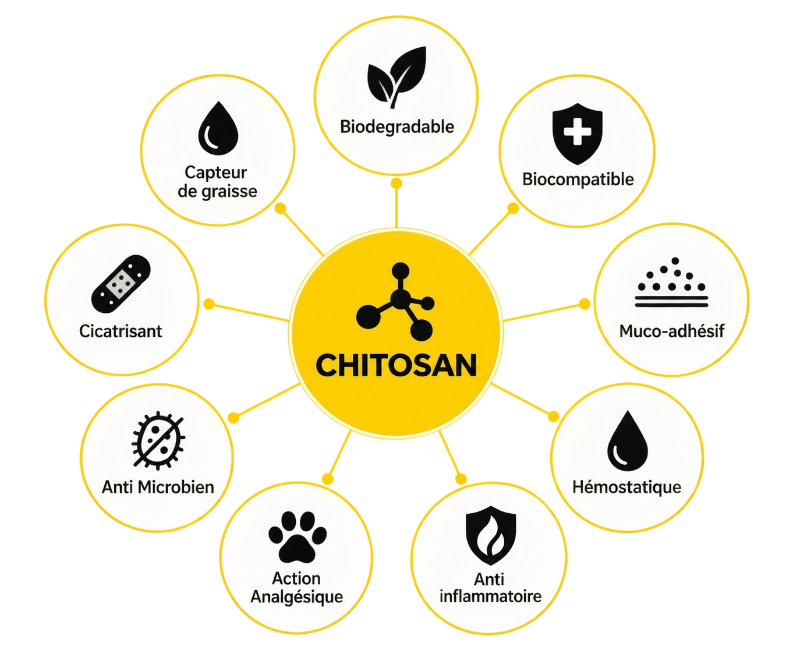
Chitosan has been widely studied as a biomaterial for various applications. Some of its key properties are listed in this image. Due to its biodegradable and biocompatible nature, chitosan has been used in both external and implantable medical devices.
As a fat binder, it has been used as a weight loss agent. Mucoadhesive and viscosity modifying properties make it useful for drug delivery. The hemostatic, antimicrobial, anti-inflammatory and analgesic properties make it an excellent wound management material.
Mechanisms of the properties of CHITOSAN
Hemostasis
Cationic Chitosan binds to negatively charged blood cells and leads to platelet activation and concentration of erythrocytes.
Antimicrobial
Positively charged molecules of Chitosan bind to negatively charged microbial cell membranes, resulting in the disruption of the microbial membrane, and subsequently the leakage of proteins and other intracellular constituents.
Pain Control
Chitosan relieves pain through its analgesic effect by reducing the concentration of inflammatory mediators (bradykinin) at the site of injury. It also absorbs proton ions released in the inflammatory site to control pain.
Wound Healing
Chitosan aids in wound healing through multiple pathways such as polymorphonuclear cell activation, fibroblast activation, cytokine production, giant cell migration, and stimulation of type IV collagen synthesis.
Prevention of Scars
Chitosan reduces the production of TNF-ß1&2, responsible for scarring. The collagen produced in the presence of Chitosan is fine reticular-like fibrils rather than mature bands of dense collagen.
Wound Care
The hemostatic action of Chitosan is based on the rapid absorption of blood plasma which leads to the concentration of erythrocytes and platelets at the injured place, followed by the activation of platelets and the coagulation of erythrocytes.
Chitosan promotes re-epithelialization by stimulating the proliferation of dermal fibroblasts and inhibiting the proliferation of keratinocytes
Chitosan acts as an antimicrobial agent by causing bacterial cell wall leakage through charge-based interaction and inhibition of mRNA and protein synthesis at bacterial nuclei
The analgesic effect of Chitosan comes from the absorption of bradykinin and proton ions at the inflammatory site, followed by blockade of the arachidonic pathway by inhibition of phospholipaseA2
Chitosan plays an important role in anti-inflammatory action by producing a significant inhibitory effect against inflammation mediators such as interleukin (IL)-2, IL-4, IL-6, l ‘IL-10 and IL-13, Cytokines such as TNF-α, Expression of NF-kβ and Activation of AP-1
Chitosan protects the digestion of the skin’s extracellular matrix by blocking the expression of matrix metalloproteinase-2.
Cosmetic
Chitosan protects the skin from exposure to UV rays and acts as a sunscreen (sun protection factor of approximately 0.89)
Chitosan acts as a cationic humectant that can easily be absorbed by the negatively charged surface of the skin and maintain the moisture content of the skin. The moisture absorption capacity increases with increasing degree of deacetylation of chitosan
The polycationic nature of chitosan helps interact with polyanionic keratin which causes a film to easily form around the hair fibers. This film improves the strength and softness of the hair and prevents damage to the hair.
Optimal pKa value to inhibit dental plaque formation around 6.3 and this value is within the range of chitosan pKa value (5.1-6.5)
Chitosan has the ability to bind to enamel to create a protective layer that reduces tooth abrasion
Pharmaceutical
Chitosan has been exploited in particular as an excipient in the pharmaceutical formulation. Due to its hydrophilic nature, it can be used as a disintegrating and binding agent for the dosage form of tablets.
The gel-forming ability of the chitosan-based polymer matrix aids in control and sustained drug delivery
Positively charged chitosan easily binds to free fatty acids and blocks the absorption of lipids in the intestine. Chitosan also emulsifies fats and disrupts lipid absorption in the gut
The high molecular weight of chitosan and the presence of amino and hydroxy groups make it suitable as a pharmaceutical excipient as a thickening agent, surfactant, emulsifier, etc.
WHY CHITOSAN PROMOTES HEMOSTASIS?
Chitosan promotes rapid hemostasis thanks to its instant muco-adhesion action. Chitosan absorbs the blood plasma (charged with Ions -), resulting in a concentration of erythrocytes and platelets at the injured site. Chitosan causes adhesion, aggregation and activation of platelets. Chitosan promotes coagulation and activation of erythrocytes due to the interaction based on the positive charge (Ions+).